
The Relief
She found a way out. She didn't take it.

There’s a specific kind of exhaustion that isn’t about sleep.
This story knows what that feels like.
Laura always ordered the same thing: a small coffee with oat milk, no sugar.
The waitress at the café in Russafa didn’t even ask anymore. She’d look up, see her come in, and start making it. Ritual without faith.
On Thursdays she had dinner with her friends. Pasta, almost always. Last week, Carla had asked what Marc was like.
Laura thought. She remembered his short laugh, the damp apartment, the repeated dishes. How her head didn’t hurt when she was with him. She wasn’t happy, but he didn’t drain her.
She said: “Normal.”
And he was. Normal to the point of fading in any room. He didn’t make jokes that sought light. Didn’t have exhibitionist wounds. He had a job she didn’t quite understand—some kind of digital marketing—and it didn’t matter. He lived in a rented flat in Cabanyal, second floor, damp in winter. He cooked four dishes and repeated them with stubborn pride. The same four his mother made, he’d said once. Laura had never seen any photo of his mother.
Laura found it restful. She’d been with people who made noise. People who turned every argument into a stage. Not Marc. Marc said he was tired and went to bed. No epics. Just days.
They met on the terrace of the Colom Market. She was waiting for a friend who never arrived. He was scrolling his phone. But his thumb wasn’t moving. Laura asked for the sugar. He pushed it toward her. Didn’t look up. She didn’t use it. Neither did he.
Three months later, Marc told her he wanted to move in with her. Not to his place in Cabanyal. To a house out of the city. Terrace, garden, quiet. Laura said she’d think about it. From that night on she noticed he looked at her as if waiting for an invisible answer. Sometimes, when walking past the second bedroom, Marc would turn his head away.
One night, eating reheated pasta, he asked her what she thought about getting a dog someday. Then he added it might be complicated, with her job, with his, with the schedules.
He let it fall like someone speaking of a dream too expensive. Laura felt a strange pang: not the desire for the dog, but the desire to have any desire clear enough to want a dog.
That night, after making love, he lay staring at the ceiling. Too quiet.
“I have to tell you something,” he said.
Laura sat up. The streetlight cut his face in two. One half she knew. One half she didn’t.
“I’ve seen you before.”
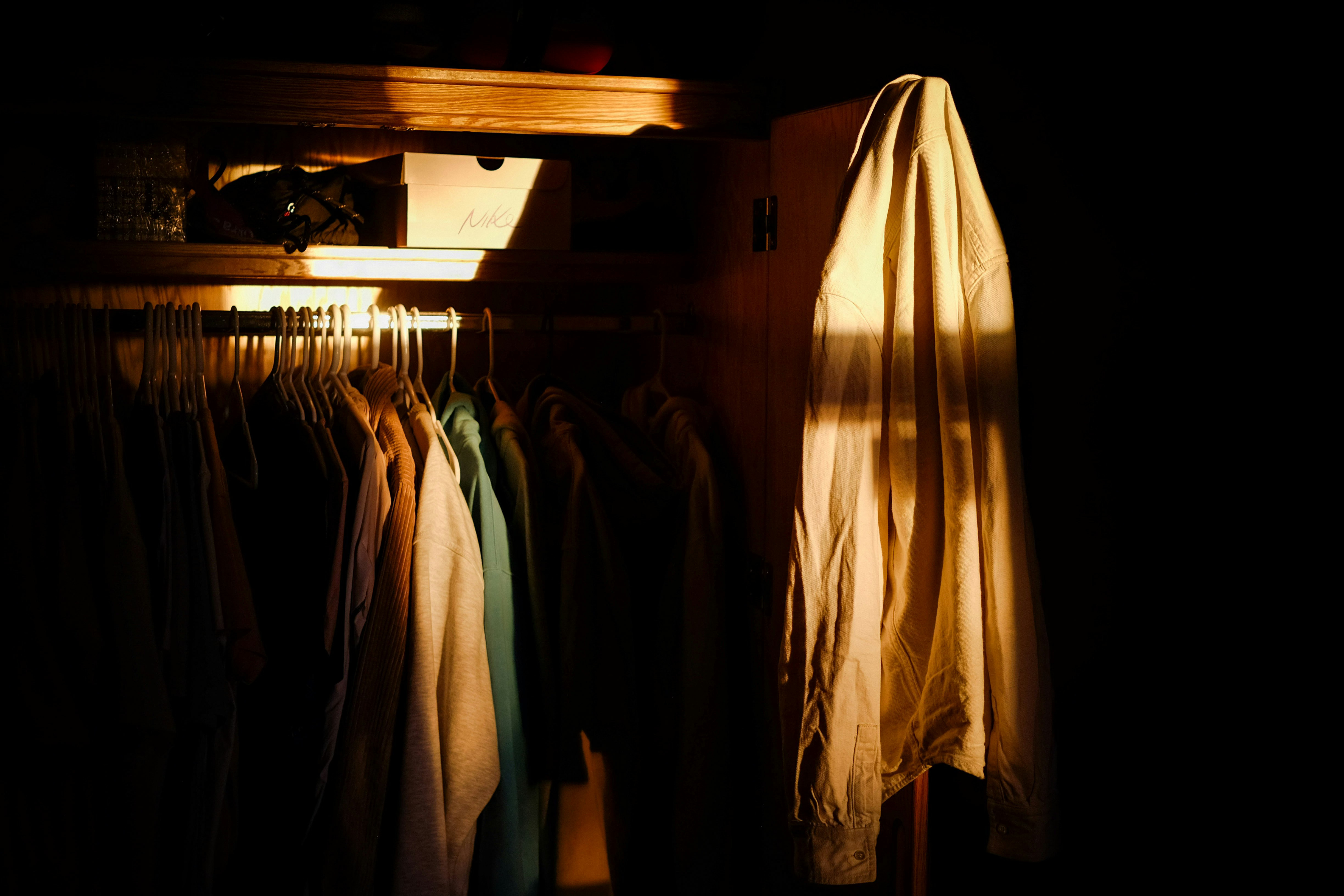
Marc’s flat had two bedrooms. The second was a storage room pretending to be a room: empty boxes, a broken fan, a guitar nobody had touched in years. The built-in wardrobe had painted wooden doors, the paint chipped at the edges. Marc used it to store everything he didn’t want to see.
One day, looking for space for more boxes, he noticed the floor inside the wardrobe sounded different. He tapped with his heel. Hollow. A hollowness that made an impossible sound: not echo, not resonance. Just a dry, deep thud, as if beneath there was neither air nor material, but pure absence.
He dropped a coin in. A twenty-cent piece. He expected to hear it ping, roll, hit something. No ping. No roll. No clink. Nothing.
It took him two weeks to pry up the tiles. His hands kept finding other things to do. On the third sleepless night he got up, grabbed a screwdriver, and began prying with care, as if afraid of hurting something alive.
There was only a hole.
Not an architectural space. Not a basement. Black in a way that didn’t reflect. Light went in and didn’t come back. The frame of broken tiles drew an irregular rectangle.
Marc put his hand in. His hand vanished. No pain, no cold. Simply not-being.
He pulled his arm back with a jolt. His chest ached.
He spent the night sitting beside the hole. At some point he realized he was holding his breath. He didn’t know for how long.
The second time he put his head in.
When he pulled it out, his tongue tasted like pennies for the rest of the night.
Afterward, the world seemed too empty.
“I don’t believe you,” Laura said.
He looked at her from the side. His pupils were dilated, but not from the dark.
“I put my head in,” he said. “And I saw you.”
“What do you mean you saw me?”
“You and me. Somewhere I don’t know. Evening light. A terrace. You were laughing. So was I. And there was a dog.”
Laura stared. No recognition. Only a tiredness she hadn’t earned yet.
“I looked for you. I knew your face.” He touched his forehead with two fingers. “And I found you.”
He paused.
“I paid your friend fifty euros not to show.”
Laura went still. Her palms were flat on the sheet. Cold.
She should have felt something. Rage, maybe. Or fear. The word stalker flickered somewhere, distant. But what arrived instead was a strange clarity: she had been chosen. Not met—chosen. Like a shirt under glass.
Her throat tightened. Somewhere in her chest, something should have moved. It didn’t. She swallowed twice before speaking.
“You saw us in the hole. How?”
“I don’t know what it is,” Marc said. “But inside… everything goes quiet. No, not quiet—happy.”
“How many times have you gone in?” Laura asked.
“Many. At first every day. Then less. And then I met you, so I didn’t need it.”
Laura nodded.
“I want to see it,” she said.
Marc didn’t move.
“Why?”
“Because you did.”
He was quiet for a long moment. His jaw tightened.
“What if you see something different?”
“Then I’ll know.”
“Know what?”
Laura didn’t answer. Marc looked at her the way someone looks at a door they’re not sure they want opened.
“Fine,” he said. But he didn’t get up. “Just—don’t stay in.”
The wardrobe was open, the hole covered with cardboard. The air in the room smelled like old water—not rotten, just forgotten.
Laura knelt. The hole was small, but dense. Heavy. The light from the window reached the threshold and stopped. It didn’t enter. It simply ceased.
“What does it feel like?” she asked.
Marc stayed by the door. He didn’t approach.
“If you want one word,” he said, “the best I can do is ‘joy’.” He swallowed. “It makes everything else feel wrong.”
Laura reached out. An inch from the void, she felt an impossible temperature: not cold, not hot—just wrong. She breathed in. No smell. She noticed the street sounds thinning, as if someone were turning the volume down.
She put her hand in.
Then the other.
She closed her eyes. Counted to three.
Then her head.
There was nothing.
She reached for her hands and found only the reaching. No light or darkness—only a vibration, very low, very slow, like the pressure before a storm, but inside her skull, and there she felt her joy—if that was the word—the relief of not-being.
A note she felt in her teeth.
Laura wanted to stay.
To not-be.
Hers wasn’t a house or a terrace.
It was this.
This quiet.
And then she came back.
Marc was waiting, eyes wet. He helped her out. He was shaking. She was too, but more finely, more internally. For a moment he looked at her as if he already knew.
“What did you see?” he said.
Laura sat on the floor. Reality had too many angles. Too many textures. Too much weight. She noticed the faint smell of damp, dust floating in a sunbeam, an itch on her knee.
“I saw you,” she said.
“The terrace?”
“No.”
“What was it?”
Laura invented an image. A house. Morning light. Marc looking at her as if she were a prize he didn’t deserve. A dog asleep on the floor, a garden behind the curtains.
“It was our home,” she said.
Marc hugged her with a desperation that hurt.
“I love you,” he said.
She let him.
The vibration sat under her ribs like a motor idling.
She didn’t move from the floor. Marc’s arms were still around her, his breath warm against her hair, but she was looking past him—at the wardrobe, at the cardboard covering the hole.
She had lied. Not a small lie, not a kind one. A lie with architecture.
She thought: this is what it costs to be loved—you become what they saw.
The vibration pulsed once, low and familiar, like a reminder.
She closed her eyes and held him back.
A week later, Marc gave her a blue dress, slightly too big. The fabric was soft, expensive. He’d chosen well—for someone.
“I saw you wearing it,” he said. “On the terrace. In my vision.”
Laura held it up. The sleeves were too long. The waist assumed a body she didn’t have. He wasn’t giving her a gift. He was giving her a costume.
She put it in the wardrobe. She didn’t try it on.
The Cabanyal flat was left behind in autumn. By winter they were in Bétera. Marc wanted a garden and a terrace. Laura let him want. The house was too clean. No salt in the air, no traffic below. The floors smelled of ammonia. Laura didn’t miss the damp, nor care for the garden.
At night, while Marc slept, Laura would stare at the ceiling. The vibration she’d felt in the hole hadn’t gone away. Some days she barely felt it. Others, everything sounded false by comparison.
She stopped tasting food. She’d chew, swallow, forget she’d eaten. At work she started skipping lunch. A colleague asked once. She said she’d already eaten. The question died there. Marc asked if she was dieting. She said she wasn’t hungry. He believed her because it was easier.
She slept in fragments now. Two hours, then awake. Three hours, then awake. Her body forgot how to stay under. Once she slept six hours straight and woke up terrified. Her body had forgotten how to rest without punishment.
One Sunday, Marc suggested lunch in the garden. He grilled vegetables, opened wine, talked about a trip to Portugal in the spring. He’d been talking about Portugal for weeks. Always spring. Always the same towns. As if he were remembering, not planning. Laura nodded at the right moments. She watched him move—the way he flipped the peppers, wiped his hands on his jeans, smiled at nothing. A man rehearsing happiness.
She tried to feel the sun on her arms. Tried to taste the wine. But beneath everything, the vibration sat like a second pulse, slower than her heart, more patient. It didn’t compete with Marc’s voice. It simply waited.
“You’re quiet,” he said.
“Just tired,” she said. And it was almost true.
She started keeping a glass of water by the bed. The glass was always full in the morning.
She wasn’t unhappy. That was the wound.
One day Marc said:
“Are you happy?”
They were on the terrace. Evening light turning everything orange. She was wearing the blue dress—Marc had laid it on the bed that morning, as if by accident. When she’d put it on, he had smiled in a way that made her skin itch. He was seeing something she hadn’t chosen.
“Yes,” she said.
“Sometimes you seem far away.”
“I’m here.”
Marc looked at her. Something moved beneath his face.
“I love you,” he said.
“Mm,” Laura said. It sounded like agreement.
She looked at the orange light. Thought of the terrace that wasn’t hers. The vision she never had. The dress she was wearing like a costume in someone else’s play.
That night she got up. Went out to the garden. The grass was wet. The sky full of stars.
She sat on the ground, hugging her knees. She heard the distant road, a barking dog, a TV going silent somewhere.
And beneath the stars, beneath everything, there was the vibration.
The same one.
The one from the hole.
She thought: I can live like this.
She thought: I can love him.
She thought: I can pretend I’m whole.
And also: when I can’t take it anymore, I can choose the relief.
She watched the stars until dawn. Then she went inside. Made coffee. Stood at the kitchen window.
When Marc came down, she handed him the cup without looking. There was only one cup.
He didn’t ask.
Her hands were steady.
That was the worst part.
Sometimes maintenance can also be tiring. And this piece captures that.
The yin to Paranoia Agent's yang. Don't we all long for a way out, yet know from instincts that the ways out are no better than what we have.